What plastic material do I need for my plastic product?
Choosing the right plastic material is an important part of developing a plastic product. The material largely determines how the product behaves during use. Does it need to be strong, stay flexible, withstand high temperatures or resist chemicals?
There are many different plastics, each with their own properties and applications. In this blog we explain what to look out for when choosing a plastic material and what influence this choice has on the injection molding process.
Find out which material fits your product with our configurator!
Please note:
This blog provides general guidelines for choosing a plastic material. The final material choice depends on the specific application and product requirements. Properties can also differ per material variant, for example due to additives or reinforcements.
Summary
- Choosing the right plastic starts with the properties your product needs.
- Factors such as strength, flexibility, temperature resistance and chemical resistance all play an important role.
- Different plastics are suitable for different applications.
- The choice of material also affects the injection molding process and the end result.
- In this blog you’ll read what to look out for when choosing a plastic material.
Watch video
Table of contents
What should you consider when choosing plastic?
Not every plastic material is suitable for every application. To make the right choice, first look at the properties your product needs. A part that needs to withstand a lot of force, for example, requires different properties than a flexible part or a product used outdoors.
Strength and impact resistance
Does your product need to withstand bumps, drops or mechanical load? Then strength and impact resistance are important properties to look at.
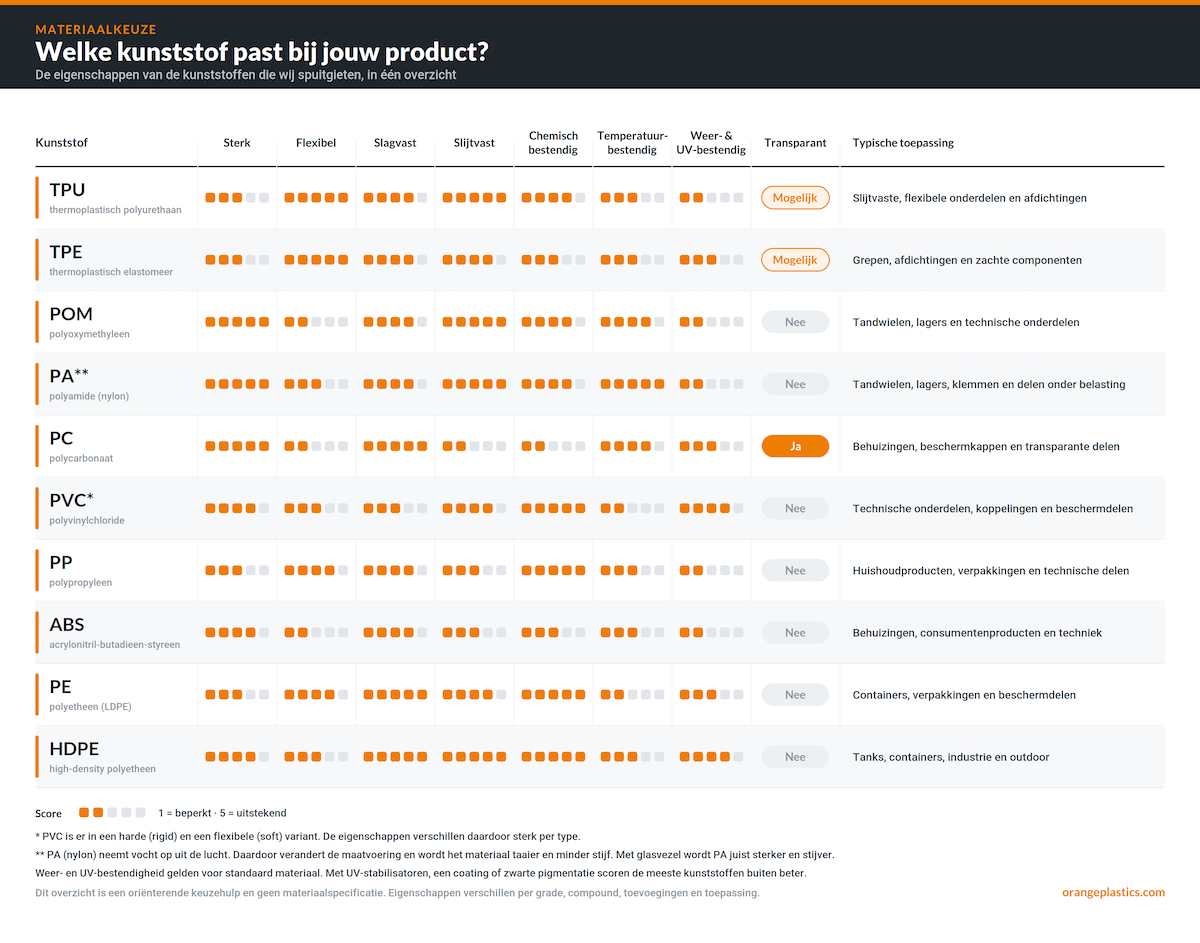
Materials such as ABS, PC and PA are used, for example, for applications where a combination of strength and impact resistance is important, such as gears and bearings. Which plastic is most suitable depends on the load and the other requirements for the product.
Flexible
Some products need to be able to bend or deform without breaking right away. Flexible plastics are interesting for this, although the degree of flexibility varies strongly per material.
PP is semi-rigid and owes its flexibility mainly to a thin wall thickness, which makes it suitable for, for example, living hinges and snap-fit connections. TPU is a true elastomer and much more rubber-like in nature, which in turn makes it interesting for applications such as grips, seals or soft components that need to absorb more deformation.
Temperature resistance
Is your plastic product exposed to high or low temperatures? Then it’s important to look at how the material behaves under those conditions.
PC and PA can be suitable for applications where higher temperatures play a role. For applications at low temperatures, PE and PP, among others, can be interesting. The exact temperature resistance differs per material variant and application.
Chemical resistance
Does your product come into contact with, for example, cleaning agents, oils or other chemicals? Then the material needs to be resistant to that.
Plastics such as PP, PE/HDPE, PVC and POM are used for various applications because of their chemical resistance. Here too, it’s important to look at exactly which substances the product comes into contact with.
Wear resistance
For moving parts or products subject to a lot of friction, wear resistance is important. You want to prevent the material from wearing down quickly due to continuous contact. POM and PA are used, for example, for parts where low friction and wear resistance are important.
UV and weather resistance
Will your product be placed outdoors? Then you also need to take into account exposure to sunlight, rain and temperature fluctuations.
HDPE and PP can be suitable for outdoor applications. For products exposed to UV radiation over a long period, a UV stabilizer can be added to the material.
Appearance
Technical properties aren’t the only factor at play. The appearance of your product can also be decisive for the material choice.
Think of, for example:
- Color
- Transparency
- Gloss
- Surface finish.
For a consumer product, a certain look and feel can be just as important as the technical properties, for example.
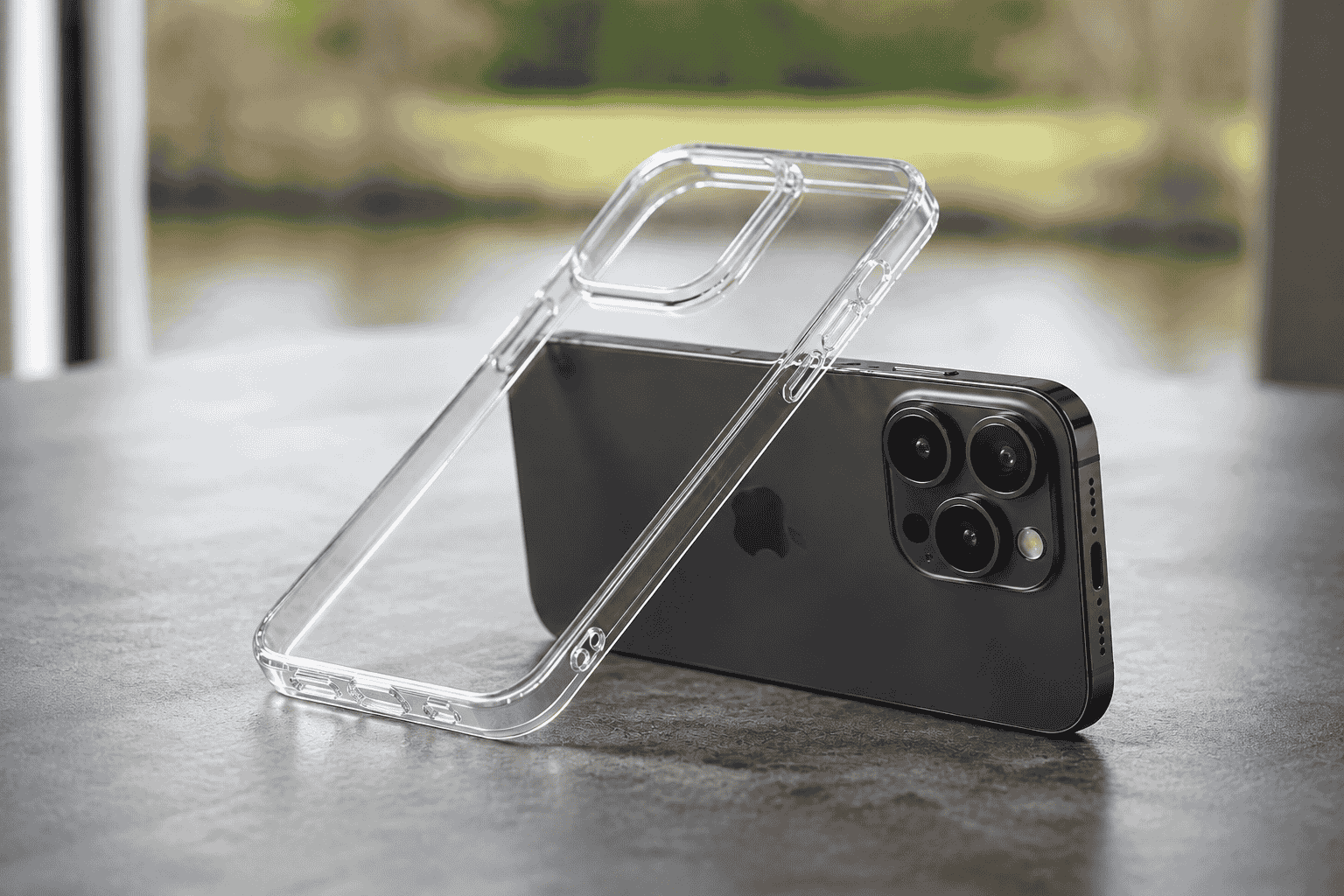
For phone cases, for example, TPU is widely used because it’s strong yet flexible.
Which plastic fits my product?
Which plastic fits your product depends on the application and the properties you need. A housing for electronics, for example, requires different properties than a flexible phone case, a gear, or a plastic part for outdoor use. So first list the most important requirements for your product, then look at which plastic best fits them.
What influence does material choice have on injection molding?
The choice of material doesn’t only affect the final product. Every plastic also behaves differently during the injection molding process.
For example, plastics differ in:
- Processing temperature
- Shrinkage
- Flow properties
- Dimensional stability
- Cycle time
- Surface quality.
These properties can also affect the design of the mold and the way the product is produced. That’s why it’s important to factor material choice into the development process at an early stage.
A material may seem technically suitable for a product, but be less suitable for the desired production method or design. By aligning material choice and design with each other, you prevent problems during production.
How do you choose the right plastic material?
Choosing a plastic starts with your product’s application. By going through the steps below, you get a better picture of which materials could be suitable.
1. Determine the application
What is your product used for? Also think about the load the product gets during use. Is it, for example, loaded, bent, exposed to heat, or used in a moving application?
2. Determine the most important properties
Then clarify which properties are important. Does the product need to be, for example, strong, flexible, wear-resistant, transparent or chemically resistant?
3. Look at the environment
The environment in which the product is used can also be decisive. Take into account, for example:
- Temperature
- Moisture
- UV radiation
- Chemicals
- Mechanical load.
4. Compare suitable materials
Once you’ve determined the most important requirements, you can compare different plastics with each other. Don’t look at just one property, but at the combination of properties your product needs.
5. Take the production process into account
The material not only needs to be suitable for the application, but also for the way you want to produce the product. With injection molding, for example, processing temperature, shrinkage and flow properties all play a role.
6. Get advice
Not sure which plastic material fits your product? Use our material selection quiz and discover which materials fit the application and properties of the product. Can’t figure it out? Then a specialist from Orange Plastics can think it through with you. We work with more than 50 types of plastics and can compare different materials based on your product and product requirements.
Which plastic fits your product?
Six short questions, then you’ll see which material fits best.
Conclusion
Choosing the right plastic starts with the application and the properties the product needs. Strength, flexibility, temperature resistance and chemical resistance are important factors, but the production process and the desired appearance also play a role. By factoring in these factors early in the design, you increase the chance of a product that fits well both technically and in terms of production.
Want your product developed?
Do you have a product idea or want a quick price indication? Get in touch and we’ll help you right away.