Vacuum forming or injection molding: how to decide what fits your project
Do you want a plastic product, cover or housing made? Then you’re facing an important choice: vacuum forming or injection molding? Both techniques have clear pros and cons. In this article we compare the two options on cost, product size, detail and volume.
Summary
- When making a plastic product (such as a cover, housing, tray or bin), you often choose between vacuum forming and injection molding.
- Vacuum forming has low start-up costs and is ideal for large covers, panels and small series (100 to 2,000 pieces).
- Injection molding requires a higher investment in a mold, but offers the lowest cost per piece, consistent wall thickness on both sides and maximum design freedom (such as snap-fits and threads).
Table of contents
The basics: how do both techniques work?
To better understand the differences, let’s first look at the basics. Both techniques shape plastic, but they do so in very different ways:
Injection Molding
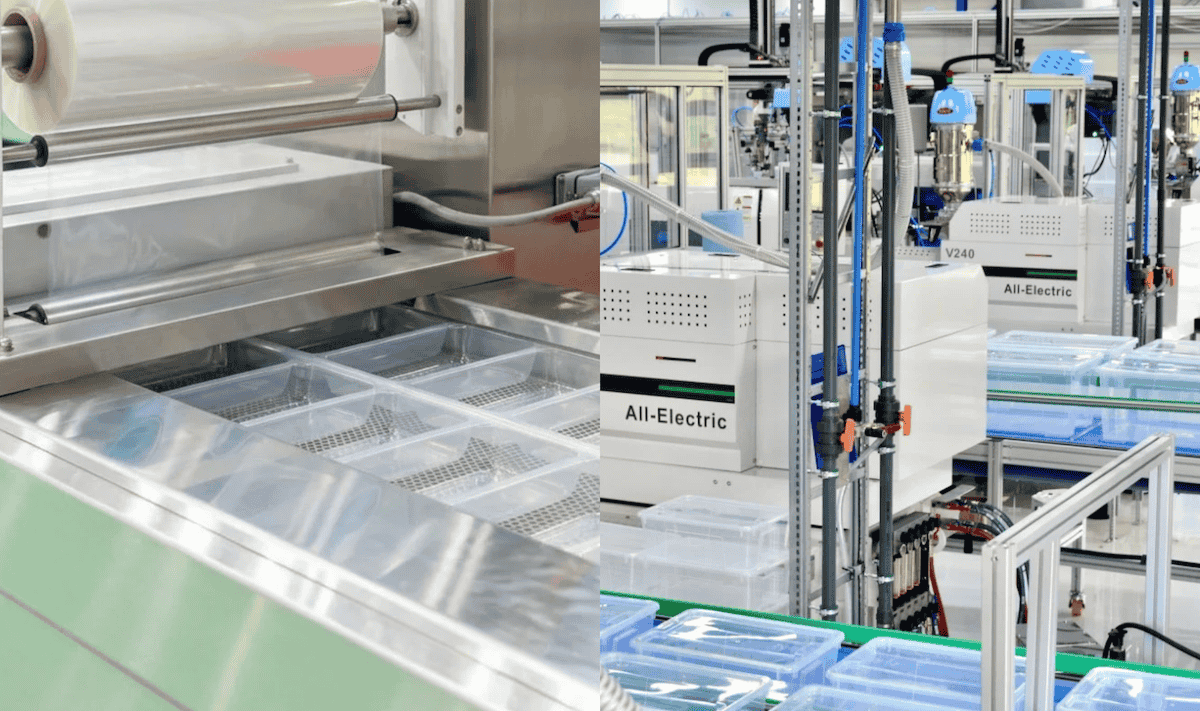
Plastic pellets melt into a liquid and are injected under high pressure into a closed steel mold. The material cools quickly and the product immediately looks sleek, edgeless and ready to use. The high pressure lets you create intricate details, varying wall thicknesses and strong internal structures.
Vacuum Forming (Thermoforming)
An existing plastic sheet is heated and drawn over a single mold. A vacuum sucks the sheet tightly against the mold. After cooling, a machine mills away the excess edges. This gives you design freedom only on the mold side. Because the sheet stretches, corners and deep points become somewhat thinner.
When do you choose vacuum forming? The advantages at a glance
Vacuum forming is the smartest choice if you want to make large parts, work with smaller series or have a limited start-up budget. The main advantages at a glance:
Low mold start-up costs
With vacuum forming, the warm plastic sheet is pulled against the mold using only vacuum (air pressure). Because hardly any physical force is applied to the mold, one simple, single-sided mold made from, for example, aluminum is already enough. With injection molding, the machine presses liquid plastic into the shape under extreme pressure. That requires a heavy, closed mold. A vacuum forming mold is therefore much cheaper to make, which keeps start-up costs low.
Ideal for very large products
Vacuum forming is the best choice for large parts, such as machine covers, vehicle dashboards, protective panels or large housings (from about 80 cm up to 2 m). For such dimensions, injection molding requires massive machines with enormous clamping forces. The steel mold that would need to be made for that quickly costs tens of thousands of euros more than a single-sided vacuum forming mold.
Attractive for small series (100 to 2,000 pieces)
Because the investment in the mold is so low, you recoup the start-up costs very quickly even with small quantities. Where injection molding sometimes requires making 10,000 pieces to earn back the expensive steel mold, vacuum forming already works out cheaper at the bottom line from just 100 to 2,000 pieces.
Short lead time and maximum design flexibility
Because a vacuum forming mold is simple and single-sided, it can often be produced within 2 to 4 weeks (compared to 8 to 16 weeks for a complex injection mold). This gives your product a much faster time-to-market. On top of that, you can still easily and affordably adjust the design afterward if your first series shows room for improvement.
When is injection molding the better choice?
Injection molding is especially suitable when quantities get higher or when the design places specific demands on shape and finish. The main reasons to choose this technique are:
The lowest cost per piece at larger quantities
Plastic pellets are a lot cheaper per kilo than ready-made plastic sheets. From 1,000 pieces onward, injection molding becomes much more cost-effective. On top of that, the machines work extremely fast: a product is often ready within a few seconds.
The product needs intricate details
Do you want to add smart details, such as snap-fit connections, threads, reinforcement ribs or a hinge? With injection molding, the machine creates all these features directly in one go. With vacuum forming that’s not possible, and you’d have to glue or assemble these parts on manually afterward.
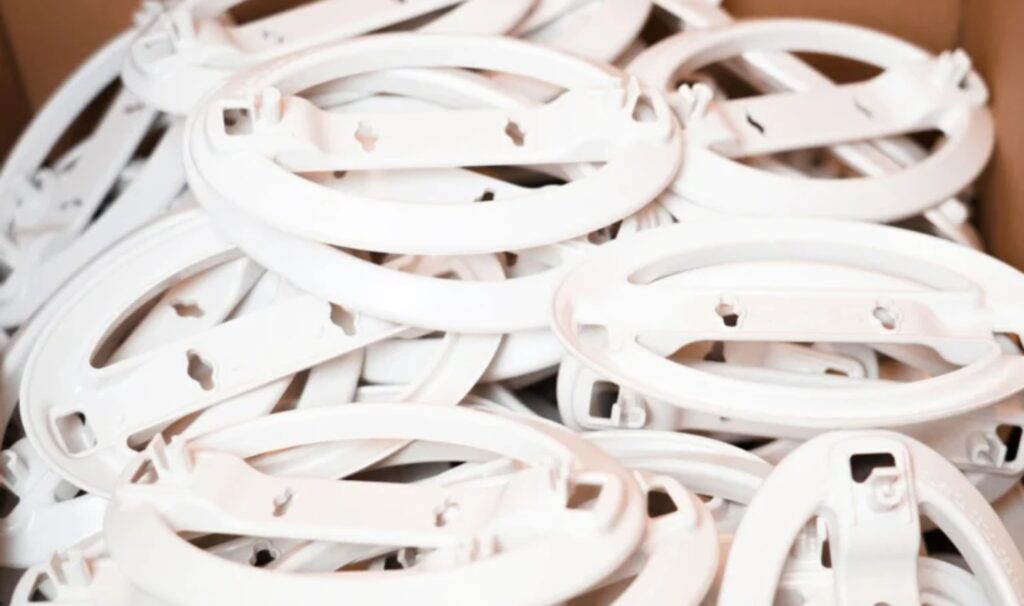
Example of an injection-molded product.
You want an even wall thickness and a tight shape everywhere
With vacuum forming, the plastic sheet stretches, which makes the corners thinner. Injection molding, on the other hand, guarantees an even wall thickness everywhere. On top of that, both sides of the product are shaped accurately to within 0.05 millimeters.
You don’t want extra work after production
A vacuum-formed product comes out of the machine as one large sheet. You always still have to mill or cut off the edges afterward. An injection-molded product comes out of the machine immediately sleek and ready to use, without any post-processing needed.
Unlimited choice of plastics
With injection molding you’re not tied to standard sheets. Do you want a product that’s extremely strong thanks to glass fiber, feels flexible (like rubber/TPE) or withstands very high temperatures? With injection molding you choose from thousands of types of plastic granulate to get exactly the right properties.
What are the costs of thermoforming and injection molding?
Curious about the costs of thermoforming (the umbrella term for techniques such as vacuum forming) compared to injection molding? The biggest difference lies in the mold start-up cost and the price per product. To determine what’s most cost-effective for your project, we look at the breakeven point.
The breakeven point in quantities
- 0 to 1,000 pieces (or very large products):
For small series, vacuum forming is the most cost-effective because the mold is cheaper. Are we talking about covers or housings from 80 cm up to more than 2 meters? Then vacuum forming is often the only option, because an injection mold for that size becomes unaffordable. - 1,000 to 2,000 pieces:
At this stage the choice depends on the finishing. Does a vacuum-formed cover still need to be trimmed by hand afterward? Or do you need to glue on separate mounting blocks? Then those extra labor costs mean injection molding already works out cheaper from 1,000 pieces. - From 2,000 pieces:
Making larger series? Then injection molding is by far the most cost-effective choice. The purchase of the steel mold is more expensive upfront, but the low price per product means you earn back that investment at higher quantities.
What should you consider beforehand in the design?
Whichever technique you choose: a good product starts with a smart 3D design. Each production method has its own specific rules you need to pay attention to when drawing.
- Designing for vacuum forming:
Because a heated plastic sheet is drawn over the mold, the material stretches. The deeper the shape, the thinner the walls and corners become. So make sure your design doesn’t have overly deep shapes or sharp internal corners. This prevents the plastic from becoming too weak in those spots. - Designing for injection molding:
With injection molding, an even wall thickness everywhere is very important. If the walls are much thicker in one spot than another, the product can warp or develop ugly sink marks after cooling. You also need the right draft angles so the product slides effortlessly out of the steel mold.
Want to know exactly how to perfectly prepare your CAD drawing? Our engineers will take a free look with you, right from your first sketch!

All the differences at a glance: vacuum forming vs. injection molding
| Aspect | Vacuum forming | Injection molding |
| Basic process | Plastic sheet is vacuum-drawn over a single mold. | Liquid plastic is injected under high pressure into a closed mold. |
| Dimensional tolerance & precision | Looser; the sheet stretches and you trim the edges afterward. | Precise, to within about ± 0.05 mm. |
| Start-up costs | Low to moderate (single-sided molds). | High (double-sided steel molds). |
| Cost per piece | Moderate (sheets are more expensive than pellets). | Low for medium to large series. |
| Product size | Large products: Very suitable for 80 cm up to more than 2 meters. | Small to medium products: Large molds (over 1 meter) quickly become expensive. |
| Wall thickness | Wall thickness varies due to stretching of the sheet (less precise). | Even wall thickness everywhere (accurate to 0.05 mm). |
| Two-sided shape | Only the mold side is sharp, the back follows the sheet. | Both sides have a sharp and exact shape. |
| Feature integration | Limited (no internal ribs, snap-fits or threads). | Excellent (snap-fit connections and threads molded in directly). |
| Material choice | Limited (plastic sheets such as ABS, HIPS or polypropylene). | Unlimited (from standard plastic to glass fiber or flexible material). |
| Surface texture | The texture is already in the plastic sheet beforehand. | The texture (matte, glossy or pattern) is etched into the mold. |
| Series size (volume) | Ideal for small to medium series (100 to 2,000 pieces). | Ideal for large series (from 1,000 to 100,000+ pieces). |
| Post-processing | Requires post-processing (milling off the edges). | Comes out of the machine immediately finished and edgeless. |
| Lead time (mold) | Short (usually 1 to 3 weeks). | Long (can take 6 to 12 weeks). |
| Best choice for | Large, simple shapes in small quantities or a first test series. | Products you’ll make for years in quantity, with fixed dimensions, features and a sharp finish. |
Not sure which technique best fits your project?
Choosing between vacuum forming and injection molding isn’t a matter of better or worse. It’s purely about your product’s dimensions, the level of detail you need and the quantities you require.
Not sure which technique is smartest for your project? Or want to know what the breakeven point is for your specific design? Our engineers are happy to take a free, no-obligation look with you.
Request a consultation with our engineers directly
Want your product developed?
Do you have a product idea or want a quick price indication? Get in touch and we’ll help you right away.