From idea to product: the full process at an injection molding company
A plastic product often starts with an idea, sketch or 3D model. But how does that idea eventually become a product that’s ready for series production?
To get there, you go through several steps. From the first intake and manufacturability analysis to the material choice, mold production and injection molding. After that, assembly and finishing may follow, before the product is packaged and shipped. In this blog we take you through the full process: from first idea to end product.
Summary
- You start with a free, no-obligation intake where your product idea, application, quantities and timeline are discussed.
- A manufacturability analysis checks whether your design is suitable for injection molding.
- The design is then developed further and you choose the right plastic material.
- The design is optimized to prevent production issues, such as burn marks and sink marks.
- The mold is then developed and tested with a first-out-of-tools.
- After approval, injection molding and series production start.
- Where needed, parts are assembled and products are finished.
- Finally, the products are inspected, packaged and shipped.
Watch video
Table of contents
1. Product idea and intake
Every plastic product starts with an idea. That can be a first sketch, an existing prototype, a 3D model or already a fully worked-out product concept. During a free, no-obligation intake we discuss exactly what you want to develop and what’s needed for that.
This looks at, among other things:
- What is the product used for?
- What properties does the product need to have?
- What quantities are desired?
- Are drawings, sketches or prototypes already available?
- When does the product need to be available?
Factors such as the desired volume and timeline are important too. This information forms the basis for the next steps in the development and production process.
2. Manufacturability analysis
A product can look good on paper, but that doesn’t automatically mean it can also be produced efficiently with injection molding. That’s why the manufacturability of the design is reviewed. This is also known as Design for Manufacturing (DFM).
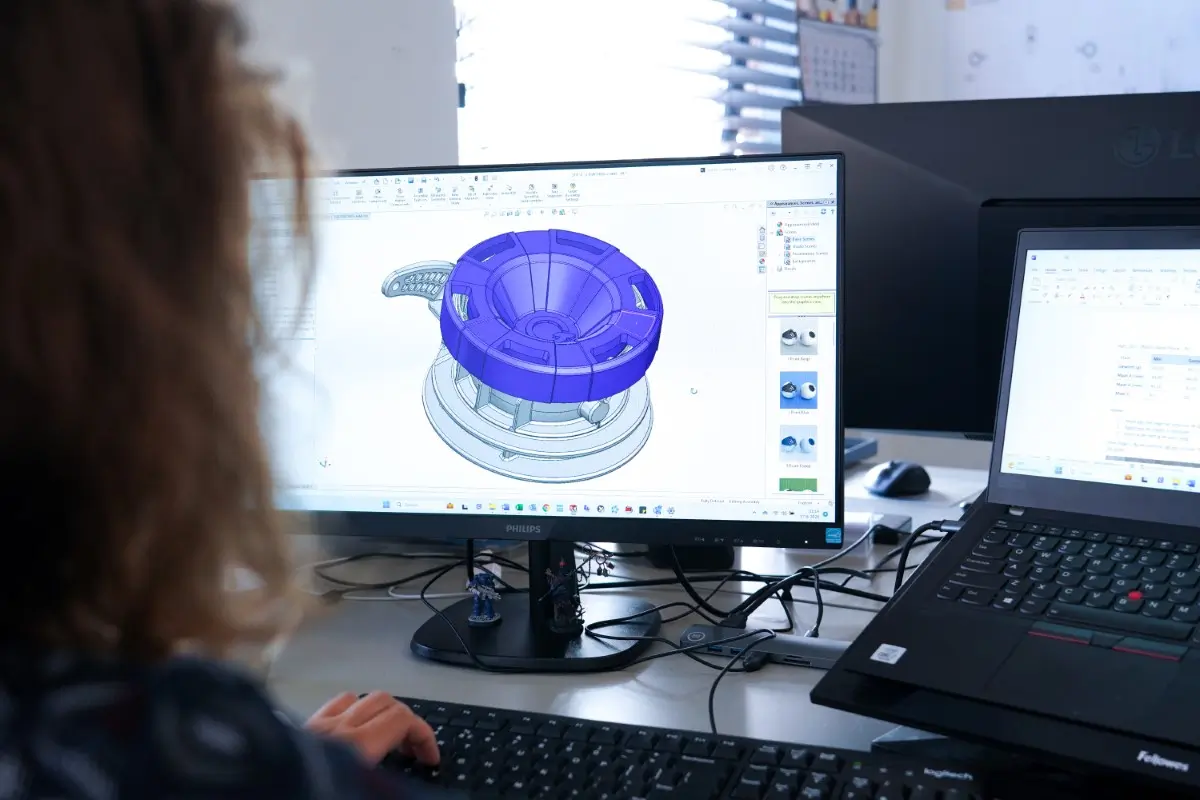
During the manufacturability analysis, we look at whether the design is suitable for efficient production. The 3D design is optimized for, among other things, manufacturability, quality and production cost. A mold flow analysis can also be carried out to see in advance how the plastic spreads through the mold. This way, potential issues such as with filling or the occurrence of injection molding defects can be identified at an early stage.
A well manufacturable design helps prevent problems during production. At the same time, design choices can affect quality, production cost and lead time. By looking at these factors early in the process, adjustments can be made before investing in a mold.
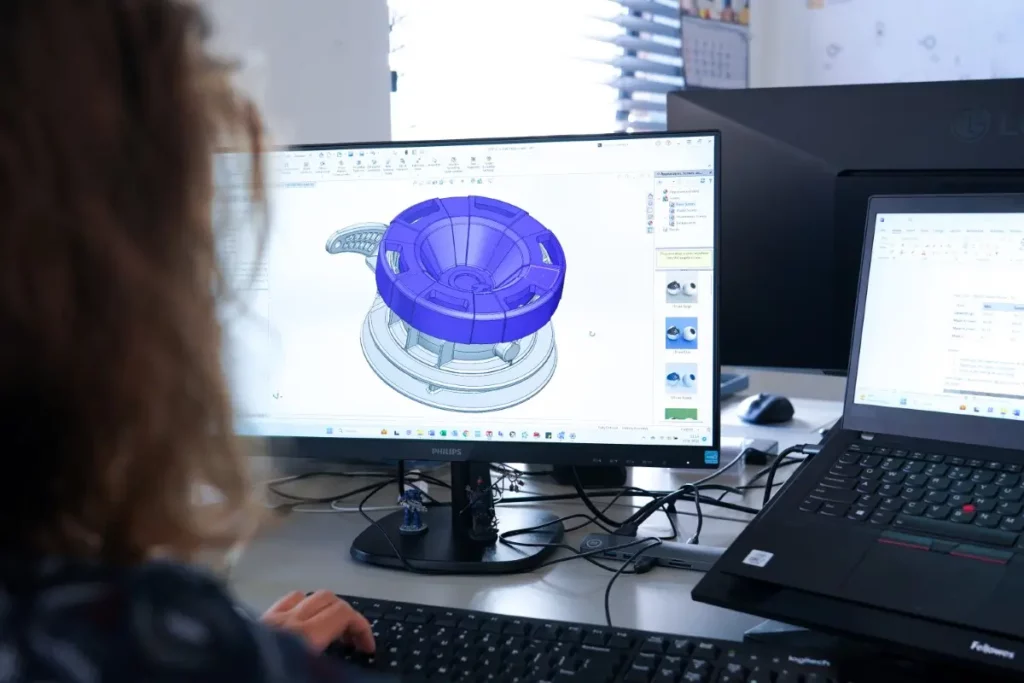
The design is optimized for manufacturability, quality and production cost.
3. 3D design and material choice
After the initial assessment, the product is developed further into a 3D design. This establishes the shape, dimensions and technical details of the product, among other things.
At the same time, we determine which plastic material best fits the application. Not every plastic has the same properties. Where impact resistance is important for one product, for example, flexibility, chemical resistance, temperature resistance or dimensional stability may play a bigger role for another.
Orange Plastics works with more than 50 types of plastics and advises on material choice based on the product’s requirements. Recycled plastics are also possible, depending on the application and the requirements set for the product.
Curious which plastic material fits your product? Read more about choosing the right plastic material.
4. Design optimization
A design that’s technically correct can often still be optimized further for the injection molding process. That’s why the design is critically reviewed once more before the mold is produced.
The goal is to identify potential production issues as early as possible. Think of burn marks or sink marks, for example. By adapting the design for this, the risk of production defects during injection molding can be reduced.
This optimization preferably takes place before the mold is built. After all, a change to a digital design is easier to make than a modification to an already produced mold. By taking the production process into account early in the design phase, unnecessary adjustments, material use and production time can be limited.
Also read: Design considerations for injection molding: how to optimize your plastic product
5. Mold production
Is the design ready for production? Then the mold can be developed. The mold is an essential part of the injection molding process: the shape of the mold ultimately determines the shape of the plastic product.
Based on the 3D product design, the mold is designed and then produced. Orange Plastics has its own mold making facility for this, which means the molds can be made in-house.
During production, various parts of the mold are precisely machined and ultimately assembled together. Next comes the first-out-of-tools. This is the first test that checks whether the mold functions properly and whether the product comes out of the mold as designed.
During this first test it becomes clear whether the mold and the product function properly. Where needed, adjustments can still be made before series production starts.
Also read: Injection molds: design and production of your plastic product.
6. Injection molding and series production
Is the mold approved? Then injection molding can begin. The plastic is injected into the mold and forms the desired product after cooling. Depending on the application, different techniques are possible, such as 2K injection molding, where two materials or colors are combined in a single product.
After the initial checks, series production can start. Orange Plastics produces both small and large series in the Netherlands and China.
Want to learn more about the process? Check out the steps of the injection molding process.
7. Assembly and finishing
A plastic part isn’t always immediately the complete end product. For some products, several parts first need to be joined together. This can be done manually, mechanically, or integrated into the production process.
Other materials can also become part of the end product. Think of metal parts incorporated into a plastic product, for example.
In addition, a product can be given a further finish. Think of:
- A coating
- Printing or a logo
- A code or other marking
- Other surface treatments.
Which form of assembly or finishing is needed depends on the product and the desired application. Orange Plastics offers, among other things, regular assembly and various forms of post-processing.
Also read: Assembly after injection molding.
8. Packaging and distribution
Before the products are shipped, they are inspected and prepared for dispatch. This includes checking whether the products meet the agreed requirements and whether they can be packaged in the right way. Good packaging protects the plastic products during storage and transport and ensures they arrive at their destination in good condition.
Orange Plastics can also handle distribution, possibly with the help of partners. This means you don’t have to arrange the logistics after production yourself, and the entire process from series production to delivery can be fully taken care of.
Why the full process matters
A good plastic product doesn’t start only at injection molding. Choices in design, material and mold all affect quality, cost and production time. By aligning these elements properly from the start, you prevent unnecessary adjustments and production issues.
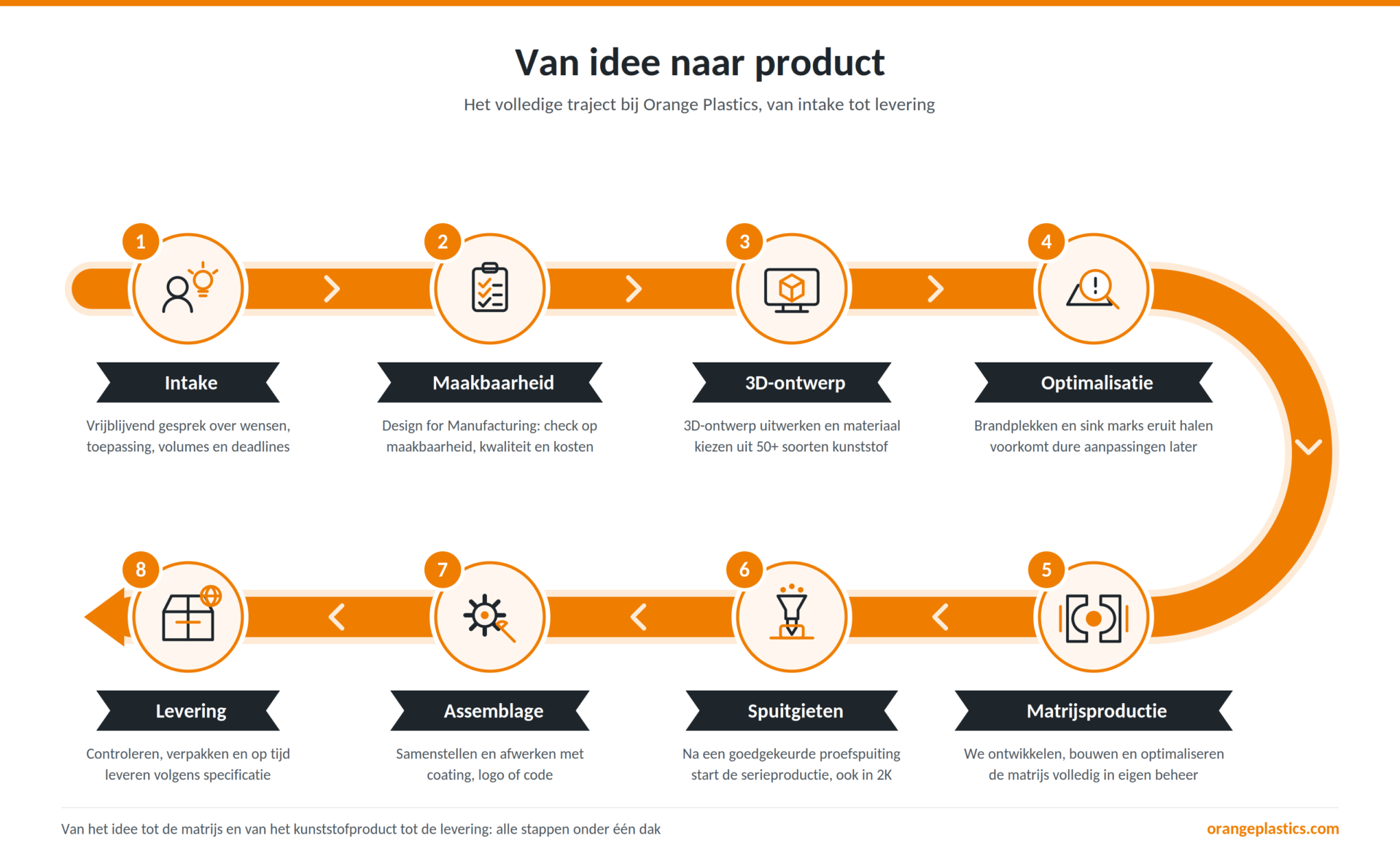
The step-by-step plan below shows what the full process at Orange Plastics looks like.
Conclusion
From an initial product idea to a plastic product ready for delivery: there’s more involved than just injection molding. By properly aligning the design, material choice, mold and production, your product can be manufactured efficiently and with the quality you want.
Want your product developed?
Do you have a product idea or want a quick price indication? Get in touch and we’ll help you right away.