Design considerations for injection molding: how to optimize your plastic product
Designing a plastic product requires more than just a good appearance. A good design also takes the injection molding process into account, ensuring that high-quality products can be produced efficiently and at low costs. In this blog, we discuss the most important design considerations: from mold flow and product ejection to smart assembly.
Summary
- Designing for injection molding requires a balance between aesthetics, manufacturability, and cost-efficient production.
- Mold flow analysis helps to optimize the filling flow and prevent defects such as sink marks and flow lines.
- A good design for product ejection uses drafts and smart mold solutions to prevent damage.
- Efficient assembly (DFA) reduces the number of parts and simplifies the production process.
- Sustainable design contributes to better recyclability and lower environmental impact.
Watch video
Table of contents
1. Mold flow analysis: optimal filling flow of plastic
When injecting molten plastic into the mold, many things can go wrong. The way the material flows through the mold largely determines the final quality of the product.
Why is mold flow important?
During plastic injection, various defects can arise if the flow is not optimal:
- Sink marks: These often occur due to walls being too thick, causing the material to cool and contract unevenly.
- Flow lines: Visible lines on the surface that appear when multiple material flows meet, for example around openings or complex shapes.
- Uneven cooling: This can lead to internal stresses and weak spots in the product.
All these defects are caused by suboptimal flow of the plastic within the mold.
Solution: simulation in advance
With mold flow analysis software, the flow behavior of plastic can be simulated before the mold is manufactured. This allows the design to be optimized for:
- A uniform filling flow
- Minimal defects
- Strong and consistent walls
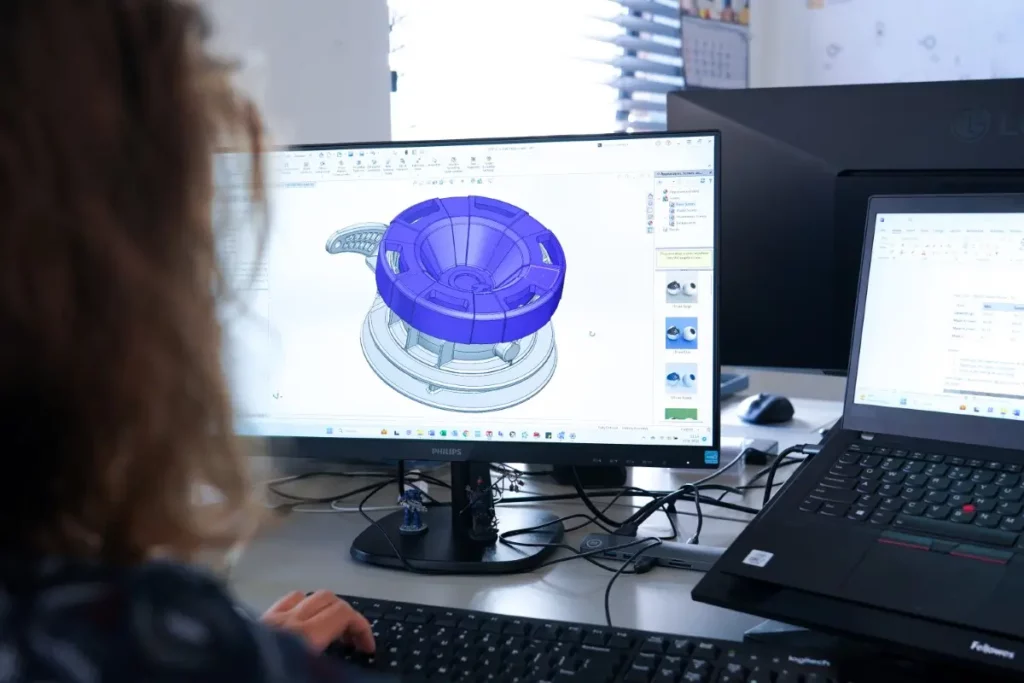
Example of a simulation using mold flow analysis software.
2. Product ejection: how to efficiently remove the product from the mold?
During the production process, it is important to work quickly and cost-effectively. Therefore, every product part must be easy to remove from the mold, with the mold taper playing a major role.
Drafts: slanted walls
Slanted walls, or drafts, help to remove the product from the mold without issues. By making walls slightly slanted rather than perpendicular, you prevent damage and simplify ejection.
How to apply this effectively?
- Product walls are not perpendicular (90°), but at a slight angle, parallel to the opening and closing of the mold.
- The optimal draft angle depends on various factors, such as:
- The depth of the part in the mold
- The function and application of the product
- The wall of the part must be optimized to withstand the full impact of ejection without damaging the component.
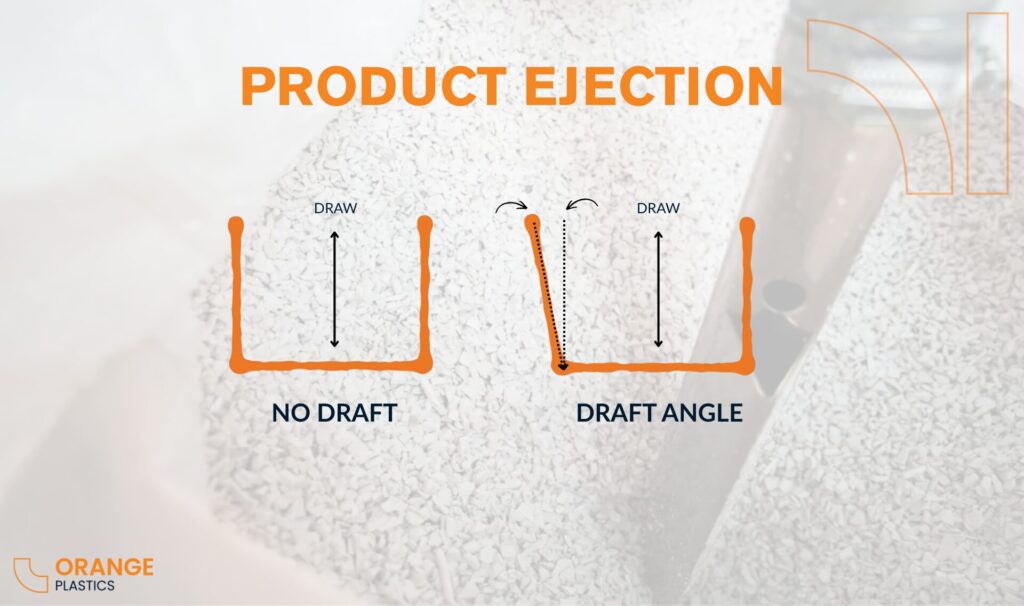
Comparative drawing of product ejection without draft and with a draft angle.
3. Assembly: minimize steps for efficiency
When designing a product, it is important to think about the assembly process at an early stage. By limiting the number of assembly steps, costs can be reduced and the production process can run more smoothly. This approach is known as ‘Design for Assembly’ (DFA).
Why smart assembly is important
Efficient assembly starts with the design. By minimizing the number of separate parts, assembly can take place faster, easier, and cheaper. Below are two ways to apply this effectively.
Design for assembly (DFA)
Through smart design choices, you can make the assembly process simpler and more efficient. Examples include:
- Minimizing separate parts.
- Using 2K molds to combine multiple components directly into one product.
Sustainable design
Sustainable design means developing products in a way that makes them easier to recycle and ensures the lowest possible impact on the environment. Key guidelines include:
- Using a single type of plastic simplifies the recycling process.
- Avoiding additions such as labels, prints, screws, or other materials.
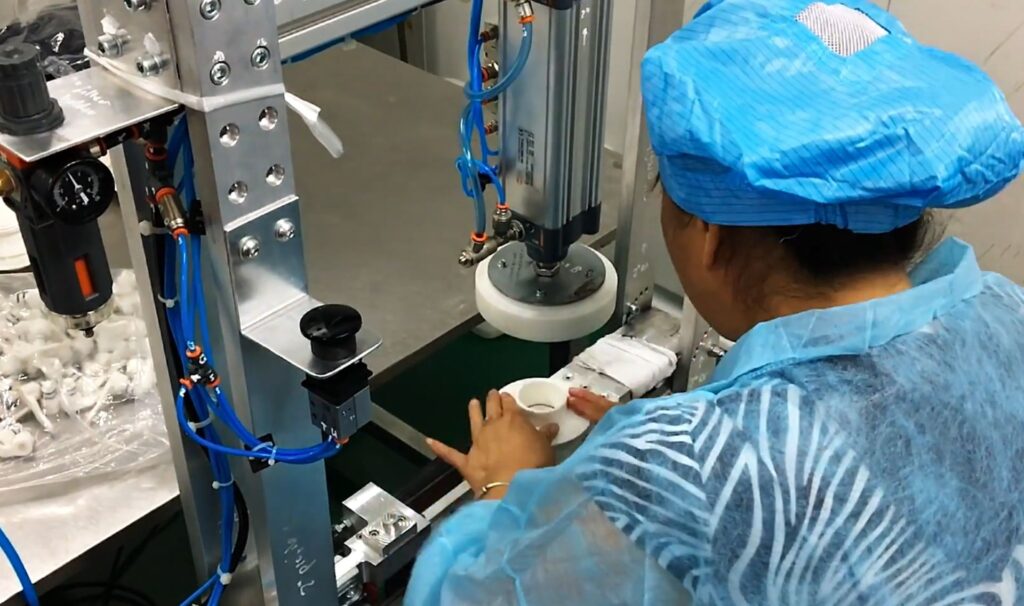
Voorbeeld van de assemblage van een kunststofproduct.
Conclusion
Designing for injection molding is about finding the right balance between efficiency, product quality, and manufacturability. Three core principles are central here:
- Mold flow: Ensure an optimal filling flow of the plastic to prevent defects like sink marks, flow lines, and uneven cooling.
- Product ejection: Design walls and drafts so that parts can be removed from the mold quickly and safely.
- Assembly: Minimize the number of assembly steps and apply smart techniques like Design for Assembly, 2K molds, or in-mold assembly, with an eye for sustainability.
By applying these design principles, you increase the quality and reliability of the product, make assembly easier, and keep production costs under control. This results in a plastic product that is both functional and efficiently producible.
Need your product developed?
Do you have a product idea or want a quick price estimate? Contact us and we will assist you right away.